
How to Build a Drawing Habit That Lasts
Make drawing a daily habit: start tiny, attach it to a routine, prepare your space, track a streak, and plan for missed days. Simple, proven habit tips.
By Ayoub Farid · · 2 min read
Most people don't fail at learning to draw because it's too hard. They fail because they stop. A habit makes drawing automatic, so you don't need motivation every day.
1. Start tiny
Make the daily minimum so small you can't say no: one sketch of one object, or two minutes of warm-ups. You can always do more.
2. Attach it to something you already do
"After I pour my morning coffee, I draw one object." Linking drawing to an existing routine makes it easier to remember.
3. Prepare your space
Leave a sketchbook and pencil out where you'll see them. Fewer steps to start = more likely to start.
4. Decide what to draw in advance
Indecision kills habits. Use a list (drawing prompts), a 30-day challenge, or a daily sketch subject.
5. Track it
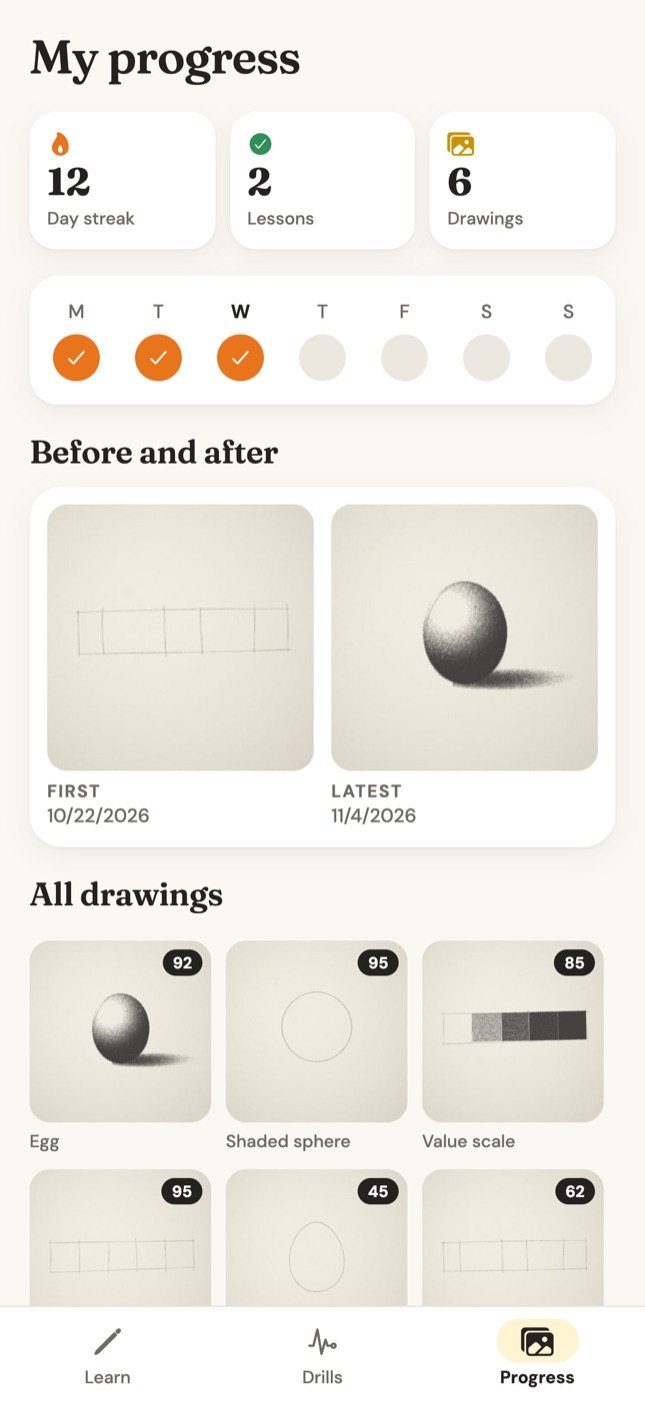
A streak, a calendar, a dated sketchbook. Seeing an unbroken run makes you want to keep it going.
6. Plan for missed days
You will miss days. Decide in advance: "If I miss a day, I do the minimum the next day." Never miss twice in a row.
7. Celebrate progress
Put your first drawing next to your latest every month. That before and after is the best reward.
8. Make it enjoyable
Draw subjects you like. Use a pencil that feels good. Listen to music. A habit you enjoy lasts.
How Graphite supports a drawing habit
- A sketch, drill or lesson a day keeps your streak going, with a week view of the days you drew.
- The daily sketch gives you a new subject every day, about five minutes.
- Two-minute warm-up drills for days when you have no paper.
- Every drawing is saved with its score, and a before & after view shows your progress.
What to do on a bad day
On days when you really don't feel like drawing, use the two-minute rule: draw one circle, one line, one tiny shaded square. It sounds silly, but it keeps the identity of "someone who draws every day" alive, and often those two minutes turn into ten. The only goal on a bad day is not to break the chain.
Frequently asked questions
How long does it take to build a drawing habit?
It varies a lot by person, often several weeks of consistent practice before it feels automatic.
What time of day is best for drawing?
Whenever you can be consistent. Mornings work for many people because fewer things interrupt.
Do streaks really help?
For many people, yes: they turn practice into a visible chain you don't want to break. Don't let a broken streak make you quit, though.