
Observational Drawing: How to Draw What You See
Learn observational drawing: look more than you draw, squint for values, measure, compare shapes and spaces, and draw from life rather than memory.
By Ayoub Farid · · 2 min read
Observational drawing means drawing what you actually see, not what you think something looks like. It's the core skill of realistic drawing, and it's very trainable.
The problem: your brain's shortcuts
Your brain stores simplified symbols: an eye is an almond with a circle, a mug is a rectangle with a handle. When you draw from memory, you draw the symbol. Observational drawing trains you to override it.
Techniques
Look more than you draw
A good ratio is looking at the subject more than at your paper. Glance, draw a little, glance again.
Squint
Squinting blurs details and shows the big light and dark shapes. Use it to plan values.
Measure
Compare sizes with your pencil at arm's length. (Proportions)
Look for shapes, not things
Draw the shape of the shadow on the mug, not "the mug". Abstract shapes are easier to see accurately.
Use negative space
Draw the gaps between objects. They correct your proportions.
Check angles
Hold your pencil vertical or horizontal and compare edges against it.
Exercises
- Blind contour of your hand (contour drawing).
- Upside-down drawing: copy a drawing turned upside down; you see shapes, not symbols.
- Still life under one lamp (still life).
- The same object daily for a week.
What observation reveals
When you really look at a mug, you notice: the bottom edge curves; the inside is darkest on the light side; the handle casts a shadow; the right edge is lighter than the band next to it. None of that is in the "mug symbol".
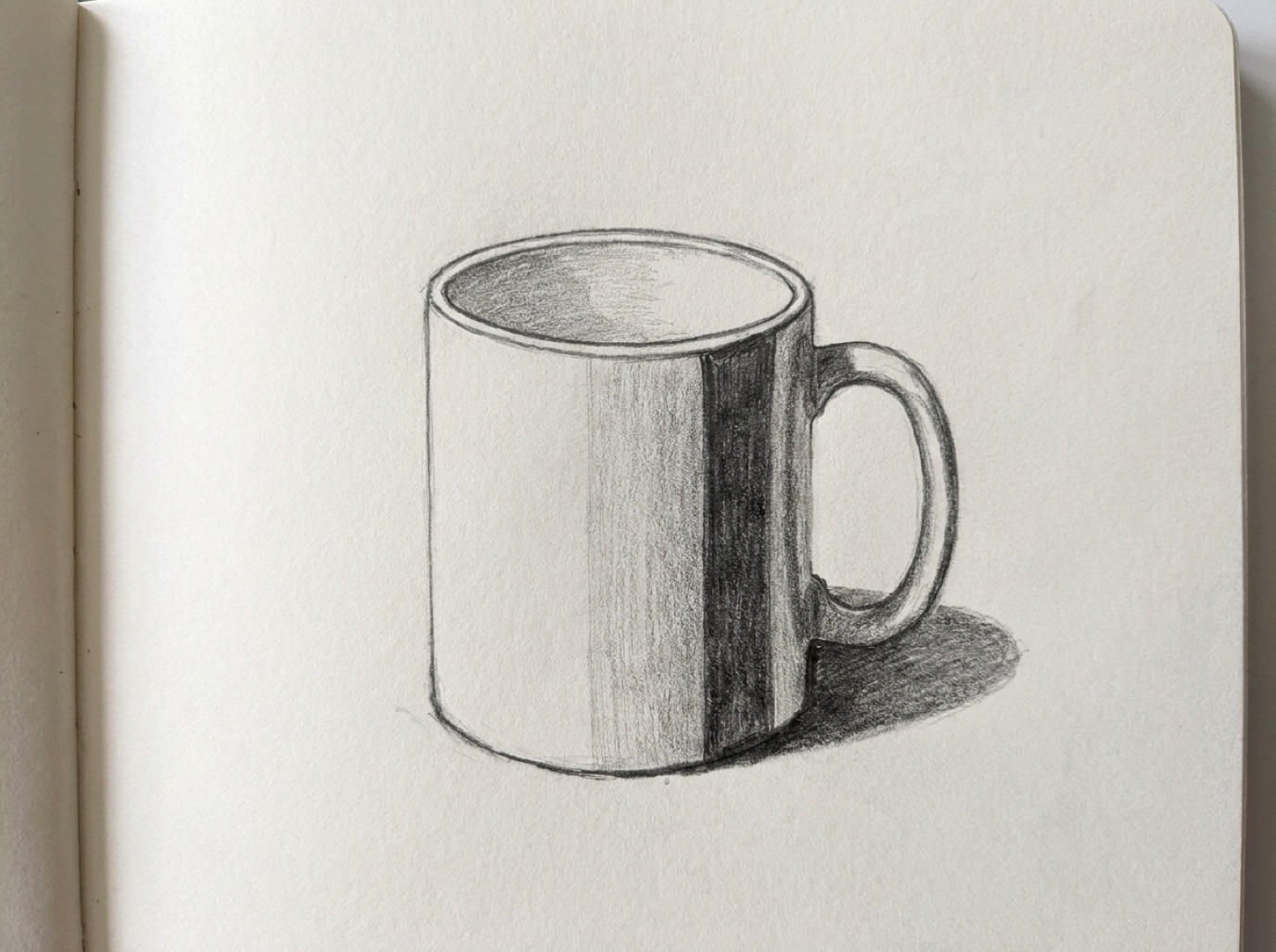
A one-week observation challenge
Draw the same mug every day for a week, under the same lamp, for 10 minutes. Each day, focus on noticing one thing:
| Day | Notice |
|---|---|
| 1 | The overall proportions |
| 2 | The shape of the shadow side |
| 3 | The cast shadow's shape and edges |
| 4 | The ellipses at the top and bottom |
| 5 | The inside of the mug |
| 6 | The handle and its shadow |
| 7 | Everything, in one drawing |
By day seven you'll see details you never noticed on day one. That's observational drawing.
Frequently asked questions
Is drawing from photos observational drawing?
Partly. You observe, but the photo has already flattened the 3D form. Draw from life when you can.
How do I stop drawing symbols?
Look at the subject more, draw shapes and values, and turn things upside down occasionally.
Does observational drawing help imagination?
Yes. Your imagination draws on what you've observed. The more you observe, the better you invent.