Hatching and Cross-Hatching: Pencil Shading With Lines
Learn hatching and cross-hatching: parallel lines for tone, layering directions for darker values, contour hatching that follows the form, and common mistakes.
By Ayoub Farid · · 2 min read
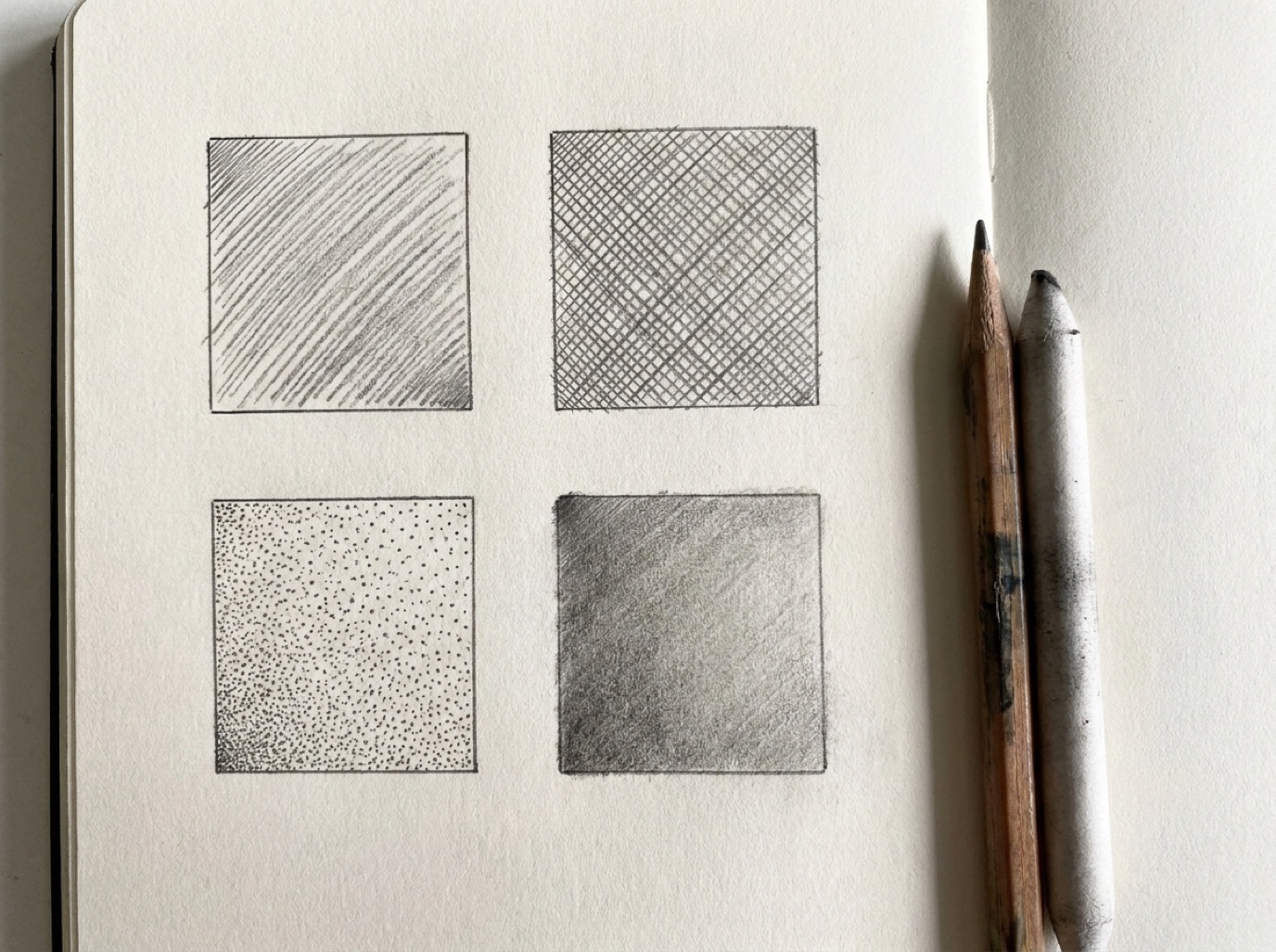
Hatching builds tone with parallel lines. Cross-hatching layers lines in different directions to go darker. It's one of the oldest shading techniques, it works with pencil and pen, and it's easier to control than smooth blending.
Hatching
- Draw parallel lines close together, all in the same direction.
- Closer lines = darker tone. Wider spacing = lighter.
- Keep spacing even; uneven gaps look messy.
- Flick the end of each stroke so it tapers.
Cross-hatching
Add a second layer of lines at an angle over the first. Each new direction darkens the tone:
- One direction: light tone
- Two directions: mid tone
- Three or four directions: dark tone
Keep angles different enough (around 30–90°) or the layers merge into a blur.
Contour hatching
Instead of straight lines, curve the hatching to follow the form, like lines wrapping around a ball. This shows shape and shade at the same time. Graphite's apple tip: "Follow the curve with your strokes, like wrapping the apple."
Practice drill
- Draw five boxes (value scale).
- Fill them with hatching only, from no lines to dense cross-hatching.
- Squint: does the tone step evenly?
Graphite's warm-up drills include Hatching: fill a box with parallel lines, evenly spaced, and get a score on your device.
Common mistakes
| Mistake | Fix |
|---|---|
| Lines like a comb, all the same length | Vary length slightly and taper the ends |
| Uneven spacing | Slow down; aim for even gaps |
| Hatching in random directions | Pick one direction per layer |
| Pressing hard for darks | Add more layers instead |
A hatching value scale
Make five boxes and fill them using only lines:
| Box | Hatching |
|---|---|
| 1 | Empty (white) |
| 2 | One layer, wide spacing |
| 3 | One layer, tight spacing |
| 4 | Two crossing layers |
| 5 | Three or four layers |
Then shade a sphere using only hatching, with lines that curve around the form.
Hatching also works beautifully with pens, so these skills carry over if you later try ink drawing.
Frequently asked questions
Is hatching better than blending?
Neither is better. Hatching shows the hand of the artist and is great for sketches; blending suits photo-like realism. Learn both. See shading techniques.
What pencil is best for hatching?
A sharp HB or 2B for fine lines; a 4B for darker hatching.
Can I blend over hatching?
Yes. Light hatching followed by gentle blending gives smooth, controlled tone.