
How to Shade With Pencil: A Beginner's Complete Guide
Learn how to shade with a pencil step by step: values, light direction, layering, smooth gradients, shadows and highlights, plus the mistakes to avoid.
By Ayoub Farid · · 2 min read
Shading is what turns a flat outline into something that looks real. It's also where most beginners get stuck: their shading looks streaky, grey all over, or in the wrong places. This guide covers the whole process, from your first value scale to a fully shaded object.
1. Understand value
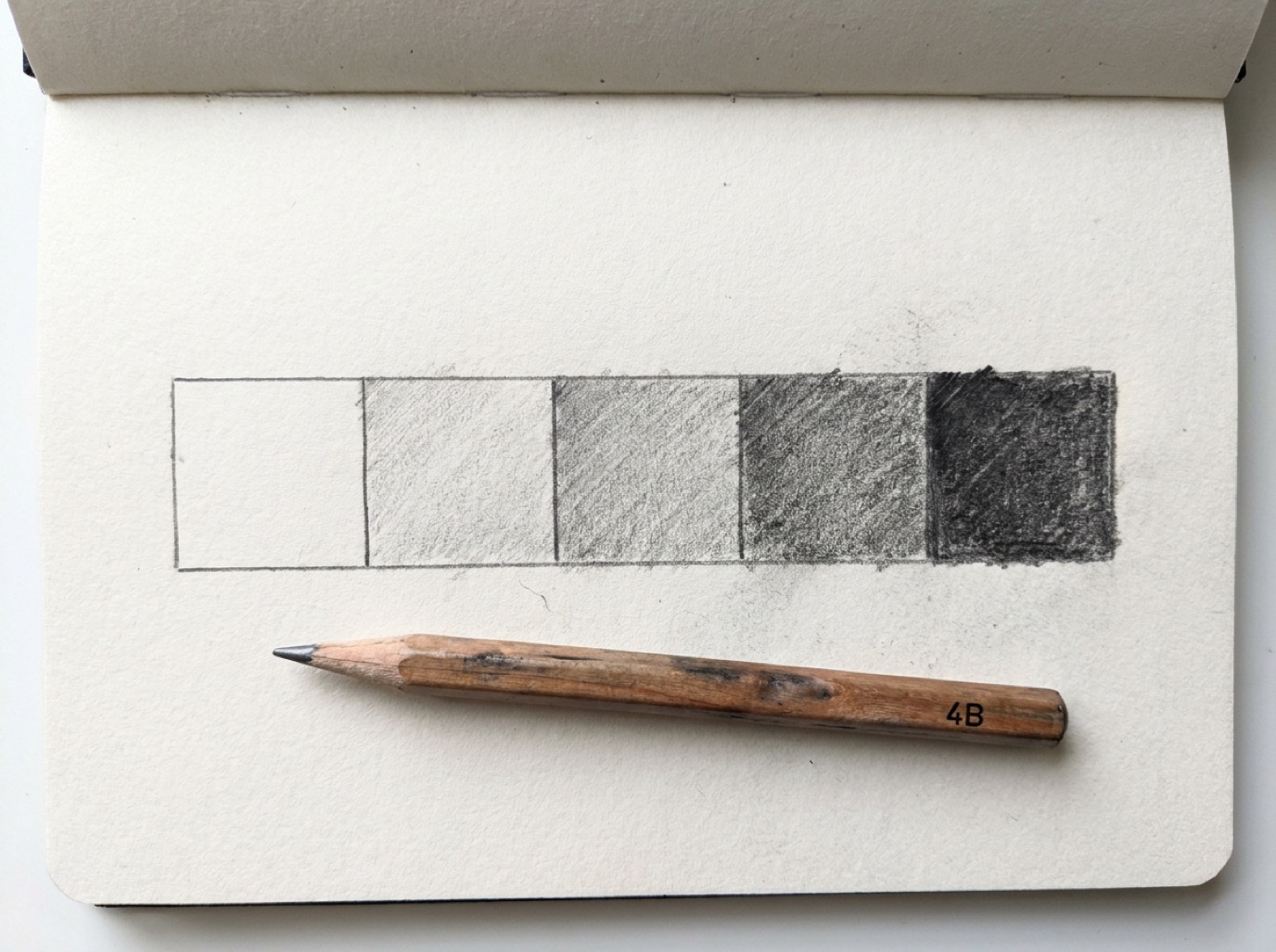
Value is how light or dark a tone is. Shading is simply placing the right values in the right places. Start with a value scale: five boxes from white to black.
2. Pick one light direction
Before you shade anything, decide where the light comes from. Top left is a good default. Every shadow in the drawing must agree with it.
3. Learn the five tones of light
On any rounded object you'll find:
- Highlight: the brightest spot, usually white paper.
- Light side (mid-tone): lit, but less than the highlight.
- Core shadow: the darkest band on the object, where it turns away from the light.
- Reflected light: a slightly lighter edge in the shadow, from light bouncing off the table.
- Cast shadow: the shadow the object throws on the surface.
Details in light and shadow in drawing.
4. Build tone in layers
- Start light with an HB or 2B.
- Add layers, pressing gently, rather than pressing hard once.
- Switch to a softer pencil (4B, 6B) for the darkest areas.
5. Choose a stroke
| Technique | Look | Guide |
|---|---|---|
| Hatching | Parallel lines, visible texture | Hatching & cross-hatching |
| Cross-hatching | Layers of crossing lines | Same |
| Stippling | Dots | Stippling |
| Smooth/blended | Even, photo-like tone | How to blend pencil |
| Contour shading | Strokes that follow the form | Shading techniques |
6. Shade a sphere
The best single exercise. Light circle → map the shadow line → shade the form (core shadow inside the edge) → cast shadow. Full guide: how to shade a sphere.
7. Check your work
Squint. Can you see a clear light side and shadow side? Is the highlight still white? Is the darkest dark where the object meets the table?
Common shading mistakes
- Dark outline around everything: flattens the form.
- Everything mid-grey: no real whites or darks.
- Core shadow on the very edge: move it inside.
- No cast shadow: the object floats.
- Blending with fingers: skin oil makes blotches.
More in why your drawings look flat.
Practice with feedback
Graphite's Light & shadow track walks you through a value scale, a shaded sphere and a realistic apple, step by step, and checks a photo of each step. The coach tells you if your core shadow is in the right place or your highlight got lost.
Frequently asked questions
What is the easiest shading technique for beginners?
Small, overlapping strokes in one direction, layered lightly, then a smoother pass. Hatching is also easy and forgiving.
Should I blend my shading?
You can, but learn to shade evenly without blending first. Blending can hide problems and make drawings look muddy.
Which pencil is best for shading?
A 2B for mid-tones and a 4B–6B for darks. See pencil grades explained.