
How to Draw a Book in Pencil (Closed Book at an Angle)
Draw a closed book lying flat at an angle: a box in perspective, three values for cover, pages and spine, page lines, and a cast shadow.
By Ayoub Farid · · 2 min read
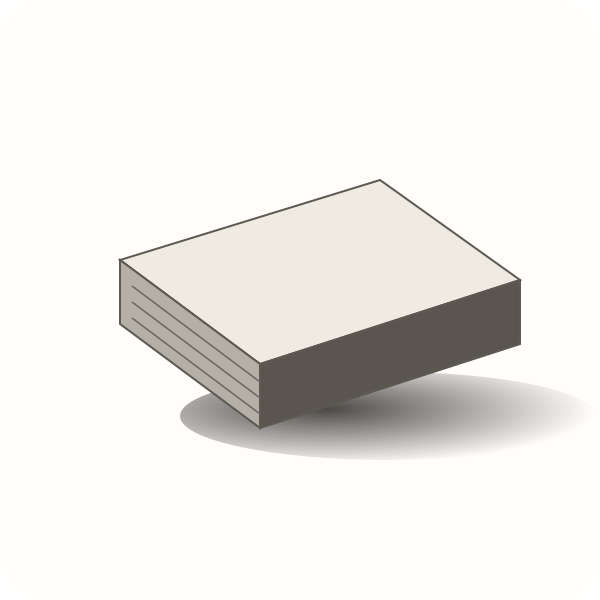
A closed book is a flat box, so it's a good next step after a cube. Graphite's daily sketch: draw a closed book lying flat at an angle. Keep the cover light, the page edges medium, and the far side dark. Add its shadow.
Step 1: The cover
Draw the top cover as a slanted parallelogram. Since the book is at an angle, opposite edges should stay roughly parallel.
Step 2: Thickness
Drop short vertical lines from the near corners, all the same length (the book's thickness), and connect them.
Edges going the same way should stay roughly parallel.
Step 3: Three values
With light from above-left:
- Cover (top): lightest
- Page edges (front side): medium
- Far side or spine: darkest
Step 4: Pages
A few thin lines along the page edges suggest the pages. Don't draw every page.
Step 5: Details
- The cover overhangs the pages slightly; show a thin edge.
- A rounded spine if it's a hardcover.
Step 6: Cast shadow
On the side away from the light, darkest along the bottom edge.
A 15-minute practice plan
- 3 min: draw the cover parallelogram three times at different angles, pick the most convincing.
- 3 min: add thickness and check all vertical edges are vertical and equal.
- 6 min: three values: cover, pages, far side. Then the page lines.
- 3 min: cast shadow and small details (cover overhang, rounded spine).
Values at a glance
| Part | Value |
|---|---|
| Cover (top) | Light |
| Page edges | Medium, with a few thin darker lines |
| Spine / far side | Dark |
| Cast shadow at the base | Darkest |
Variations
- A stack of three books: each book casts a thin shadow on the one below, and the covers can overhang.
- A book standing upright: now the spine faces you; shade it like a narrow box.
- A paperback: softer, slightly rounded edges and a thinner cover.
Troubleshooting
- Pages look like stripes: use fewer, lighter lines and vary their spacing.
- Book looks like a brick: add the thin cover edge that overhangs the pages.
Frequently asked questions
How do I draw an open book?
Two curved page blocks meeting at a center fold. Start with closed books first.
Why does my book look warped?
Parallel edges aren't parallel. Check them with your pencil held at the same angle.
Do I need perspective?
For a small book, keeping edges parallel is enough. For a stack on a desk, use perspective.