How to Draw a Cylinder and Shade It (Can, Mug, Candle)
Draw and shade a cylinder: matching ellipses, straight sides, and vertical shading bands with the darkest band just before the shadow edge.
By Ayoub Farid · · 2 min read
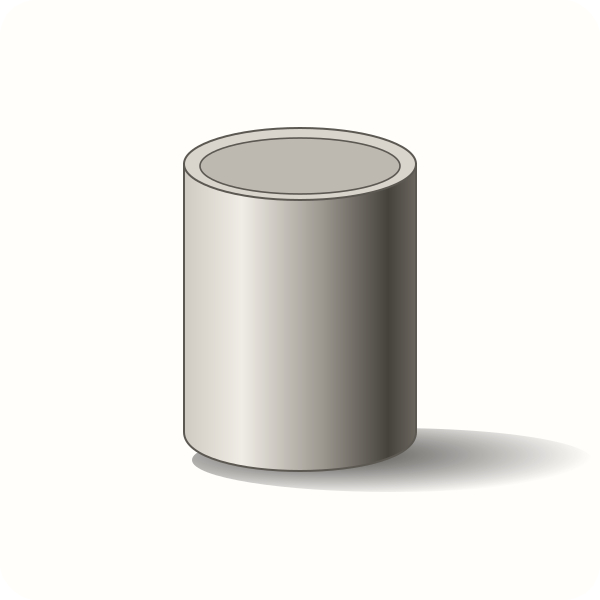
Cylinders are everywhere: cans, mugs, candles, bottles, tree trunks, fingers. Graphite's daily sketch for a can says: draw a can with an oval top and a curved bottom edge, shade it in vertical bands, and add its shadow.
Step 1: Center line
Draw a light vertical line. Everything is symmetrical around it.
Step 2: Top ellipse
Draw an ellipse centered on the line. The flatter the ellipse, the closer the top is to your eye level.
Step 3: Sides
Two vertical lines from the ends of the ellipse, parallel to the center line.
Step 4: Bottom curve
The bottom edge curves the same way as the top, usually a little rounder (you see it from further above). Draw the full ellipse lightly, then erase the hidden back half.
Step 5: Shade in vertical bands
Light from the top left:
| Band (left → right) | Value |
|---|---|
| Left edge | Light-medium |
| A little in from the left | Lightest (highlight band) |
| Center | Medium |
| A little in from the right | Darkest (core shadow) |
| Right edge | Slightly lighter (reflected light) |
Graphite's tip: "Cylinders are darkest in a band just before the right edge. The right edge is a little lighter than that band."
Step 6: Top and shadow
The top of a can is lighter (facing up toward the light). Add the cast shadow to the lower right, darkest at the base.
A 10-minute practice plan
- 2 min: three ellipses of different widths inside long boxes.
- 3 min: a cylinder with a center line, top ellipse, sides and curved base.
- 4 min: five shading bands.
- 1 min: cast shadow.
Ellipse cheat sheet
| Where the ellipse is | How it looks |
|---|---|
| At eye level | Almost a straight line |
| A little below eye level | Thin |
| Far below eye level | Rounder |
| Directly below you | A circle |
That's why the bottom of a cylinder on a table is usually a little rounder than its top.
Variations
- A cylinder lying on its side: the ellipses face you; shading bands run horizontally along the length.
- A tapered cylinder (a cup or vase): the base ellipse is smaller than the top.
- A hollow cylinder (a pipe or a toilet roll): the inside is dark on the light side, like a mug.
Frequently asked questions
Why does my cylinder look flat?
Missing the light band and core-shadow band. Shade vertically in bands, not evenly.
Why does the bottom look wrong?
A straight bottom edge. It must curve like the top.