
How to Read a Drawing Critique and Turn It Into Progress
Learn what common drawing critique terms mean (values, edges, core shadow, proportion) and how to turn each note into a concrete fix with your pencil.
By Ayoub Farid · · 2 min read
A critique is only useful if you understand it. "Your values are compressed" or "the edges are too hard" sounds like jargon until someone shows you what to do about it.
This guide translates common critique notes into plain actions.
Start with what's working
Good critique starts with strengths for a reason: they tell you what to keep doing. If the coach says "your pencil pressure is light and even", don't change your grip next time.
Common critique notes and what to do
| You hear | It means | What to do |
|---|---|---|
| "Values are too close" / "compressed" | Everything is mid-grey; no real lights or darks | Leave the highlight white and push your darkest dark with a softer pencil |
| "Outline is too dark" | A hard line around the object makes it look flat | Draw outlines lightly; let shading define the edge |
| "Core shadow on the edge" | The darkest band hugs the outline | Move it inside, where light turns into shadow (core shadow) |
| "No cast shadow" / "floating" | The object doesn't sit on a surface | Add a shadow on the table, darkest at the contact point (cast shadow) |
| "Edges are all the same" | Every edge is equally sharp | Soften edges in shadow, keep them crisp in light (hard and soft edges) |
| "Proportions are off" | Sizes or spacing don't match | Measure with your pencil, mark with light ticks (proportions) |
| "Streaky shading" | Visible stroke direction, gaps | Layer lightly in small overlapping strokes (shade smoothly) |
Read a critique in three passes
- Strengths: note them. These are habits.
- The first fix: this is the most important. Do only this on your next attempt.
- The tip: keep it in mind for the next step or the next drawing.
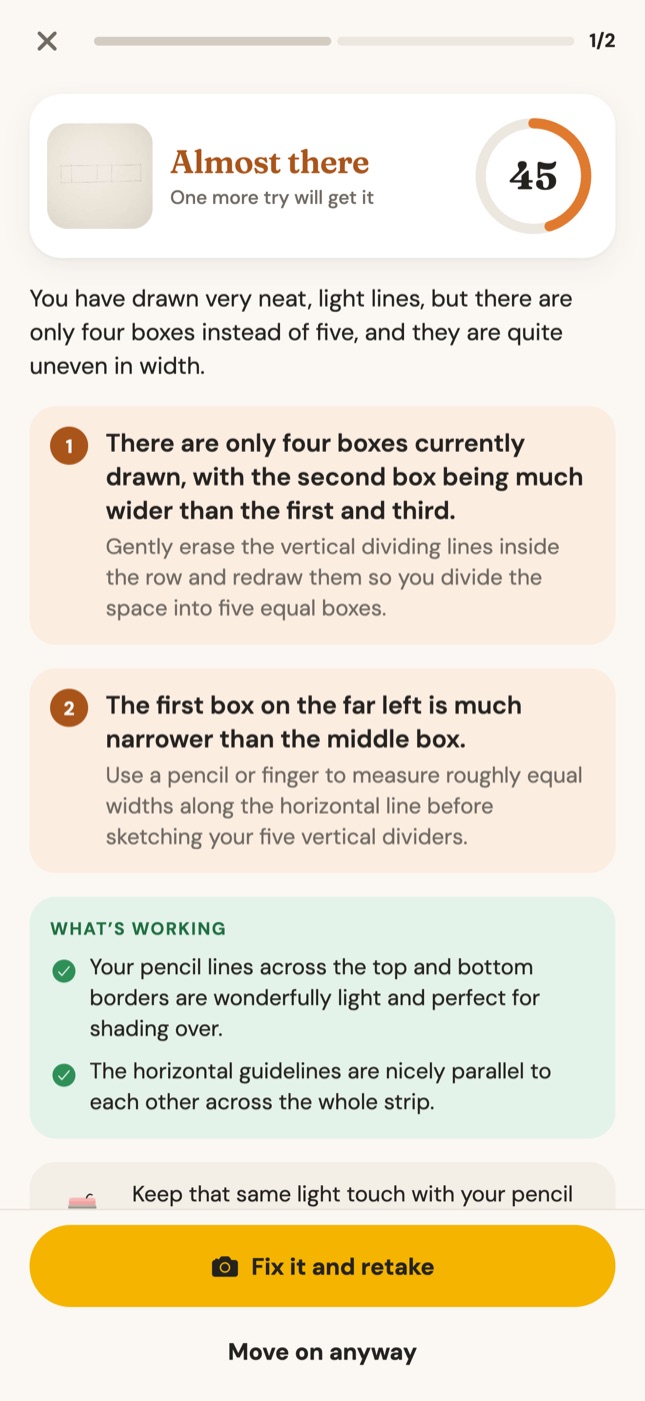
Don't argue with the photo
If feedback seems wrong, check the photo before the drawing. Shadows from your phone, a tilted angle or yellow lamp light can change how values read. Retake it from straight above in daylight and see if the note changes. See how to photograph your drawing.
Retake or move on?
- Score close to passing and one clear fix? Retake: fixing it now teaches the most.
- Several fixes and you're tired? Move on and come back tomorrow. Tired hands draw worse.
In Graphite, a score of 60 or more passes the step, but you can always move on anyway.
Frequently asked questions
Why do critiques only give one or two fixes?
Because you can only work on one or two things at a time. A list of ten problems doesn't tell you where to start.
What does "values" mean in drawing?
Value is how light or dark a tone is, from white paper to the darkest graphite. See the value scale.
Should I erase and fix, or start again?
For small fixes (darkening a shadow), fix the same drawing. For proportion problems, starting fresh is often faster.