
Reflected Light in Drawing: The Secret to Rounder Objects
What reflected light is, where it appears in the shadow side of an object, how bright it should be, and how to draw it with pencil without overdoing it.
By Ayoub Farid · · 2 min read
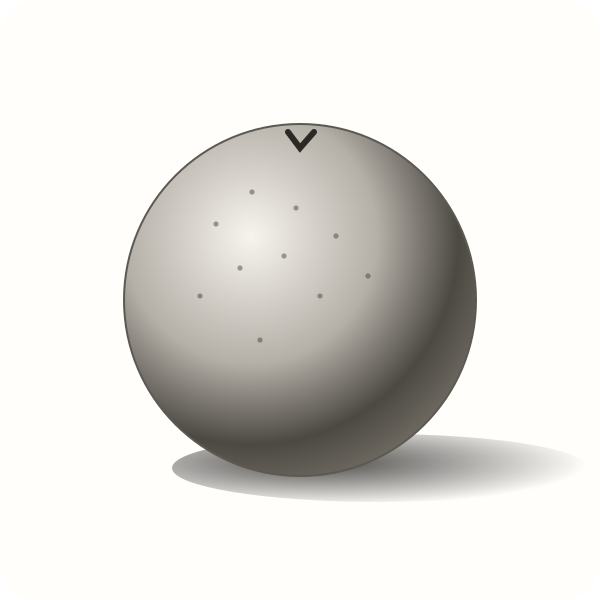
Reflected light is the subtle, slightly lighter area inside an object's shadow, caused by light bouncing off nearby surfaces. It's small, but it's what makes a sphere look like a ball instead of a disc.
Where it comes from
Light hits the table, bounces up, and faintly lights the underside of the object. So the shadow side isn't one flat dark: the core shadow is darkest, and the area near the bottom edge is a bit lighter.
Where to put it
- On the shadow side, between the core shadow and the edge.
- Usually along the bottom edge (light bouncing up from the table).
- On the side facing a nearby light-colored surface.
How bright should it be?
This is where beginners overdo it. Reflected light is always darker than the light side. If it's as bright as the lit side, the object looks lit from two directions or turns into a crescent moon.
A good rule: reflected light is one or two steps lighter than the core shadow on your value scale, no more.
How to draw it
- Shade the whole shadow side.
- Darken the core shadow band.
- Leave (or gently lift with a kneaded eraser) a slightly lighter band near the edge.
- Keep the outermost edge of the object soft; don't draw a hard dark line around it.
Graphite's sphere lesson puts it simply: "Leave a slightly lighter rim on the ball's bottom edge. That lighter rim is light bouncing back from the table."
Practice
Put an egg on a white sheet of paper and another on a dark cloth, under the same lamp. Draw both. On the white paper, the reflected light is clearly visible; on the dark cloth, it almost disappears. This simple comparison teaches reflected light better than any rule, and shows why it must stay darker than the lit side.
Once you've seen it on a real egg, look for reflected light on everything around you: mugs, fruit, even your own hand on the table.
Frequently asked questions
Does every object have reflected light?
Most do, if there's a surface nearby to bounce light. On a dark tablecloth, it's very faint.
Why does my sphere look like it has a halo?
The reflected light is too bright or too wide. Darken it so it's clearly part of the shadow.
Do cubes have reflected light?
Yes, shadow planes of a cube can be slightly lighter near the bottom, but it's subtler than on round forms.
Related: core shadow, light and shadow in drawing.