
How to Draw an Orange in Pencil (Sphere With Texture)
Draw a realistic orange: a round sphere with a small stem mark, sphere shading lit from the top left, tiny dots for the bumpy peel, and a cast shadow.
By Ayoub Farid · · 2 min read
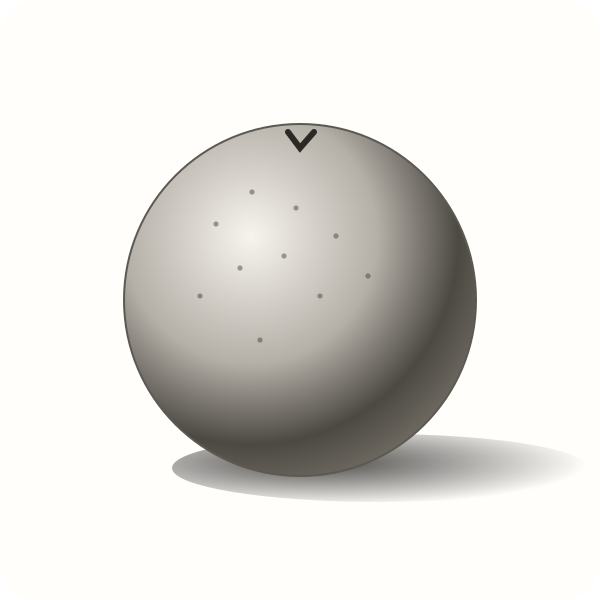
An orange is the shaded sphere with a texture. Graphite's daily sketch: draw a round orange with a small mark for the stem. Shade it with light from the top left, and add its shadow.
Step 1: The circle
A round circle, slightly flattened top and bottom. Mark the stem as a small star or dot near the top.
Step 2: Shade it like a sphere
- Highlight: upper left, softer than an apple's (the peel is less shiny).
- Core shadow: curved band on the lower right, inside the edge.
- Reflected light: slightly lighter rim at the bottom right.
Step 3: Texture
Tiny dots near the highlight suggest the bumpy skin. A few small circles or dots in the mid-tones. Little or no texture in the deep shadow.
Step 4: The stem
The stem area is a slight dip: a little shadow around it.
Step 5: Cast shadow
To the lower right, darkest at the contact point.
Tips
- Get the sphere shading right first; texture is the last 10%.
- Lift a few pores in the highlight with a pointed kneaded eraser.
Value plan
| Area | Value |
|---|---|
| Highlight (soft) | 1 |
| Light side | 2 |
| Core shadow band | 4 |
| Reflected light | 3 |
| Cast shadow near contact | 5 |
A 15-minute practice plan
- 2 min: circle and stem mark.
- 8 min: shade it as a sphere until it looks round without texture. This is the important part.
- 3 min: add the peel texture in the mid-tones and around the highlight.
- 2 min: cast shadow and contact shadow.
Variations
- Half an orange: the cut face is a flat ellipse with segments radiating from the center, lighter than the peel.
- A clementine or mandarin: slightly flatter, often with a leaf.
- Three oranges: practice overlapping and the shadows they cast on each other.
Troubleshooting
- Looks like a golf ball: the texture is too regular and too dark. Use fewer, lighter, irregular dots.
- Looks like a flat disc: the core shadow is on the edge. Move it inside (core shadow).
Oranges are a great bridge between the sphere lesson and textured subjects.
Frequently asked questions
How do I make it look like an orange and not a ball?
The stem mark and the dotted peel texture, plus a slightly flattened shape.
Should the orange be dark in pencil?
Oranges are mid-value fruits; keep the light side fairly light and the shadow side medium-dark.
What's next?
A lemon, or a still life with several fruits.