
Basic Shapes in Drawing: Spheres, Cubes, Cylinders and Cones
Most objects are built from a few basic forms: sphere, cube, cylinder and cone. Learn to see and shade them, and drawing real objects gets much easier.
By Ayoub Farid · · 2 min read
An apple is a sphere. A mug is a cylinder. A book is a box. A carrot is a cone. One of the most useful habits in drawing is to see the simple form hiding inside every object, draw that first, then add the details.
Shapes vs forms
- Shapes are flat: circle, square, triangle.
- Forms are 3D: sphere, cube, cylinder, cone.
Realistic drawing is about turning shapes into forms with light and shadow.
The four basic forms
Sphere
Gradual light-to-dark transition, a core shadow, a highlight. Examples: oranges, eyes, heads. Guide: how to shade a sphere.
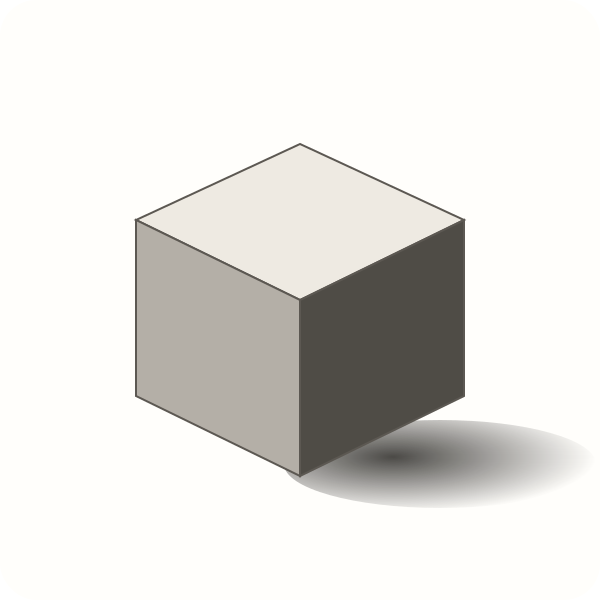
Cube
Flat planes, each with one value: top lightest, side medium, side darkest. Examples: books, boxes, buildings. Guide: how to draw a cube.
Cylinder
Shaded in vertical bands; elliptical top and bottom. Examples: mugs, cans, candles. Guide: how to draw a cylinder.
Cone
Shading narrows toward the point; curved base. Examples: carrots, party hats, the tip of a pencil. Guide: how to draw a cone.
How to use basic forms
- Look at the object and ask: which form is it closest to?
- Sketch that form lightly, at the right size and angle.
- Shade it as that form with one light source.
- Adjust and add details (stem, handle, texture).
Combinations
Many objects combine forms:
- A pear: two overlapping spheres (pear).
- A mushroom: a half-sphere on a cylinder (mushroom).
- A candle: a cylinder with a teardrop flame (candle).
Practice
Graphite's daily sketch cycles through exactly these: egg, pear, mug, cube, can, cone, lemon, pebble, cherries, bowl, book, orange, mushroom and candle. Each one is a basic form with a twist.
Practice: find the forms around you
Spend five minutes looking around the room and listing objects by their basic form: the lamp shade is a truncated cone, the remote control is a long box, the plant pot is a tapered cylinder, the doorknob is a sphere. Then pick one object from each category and draw it, starting with the basic form and only then adding the details. Within a week, you'll start seeing the hidden forms automatically, and every new subject will feel far less intimidating.
Frequently asked questions
Why do artists draw basic shapes first?
Because proportion and light are easier to get right on a simple form. Details added to a correct form look right; details on a wrong form never do.
Which basic form should I practice first?
The sphere. It teaches gradual shading, which is the hardest of the four.
Do I need perspective to draw a cube?
A little. Keep parallel edges leaning the same way. See one-point perspective.